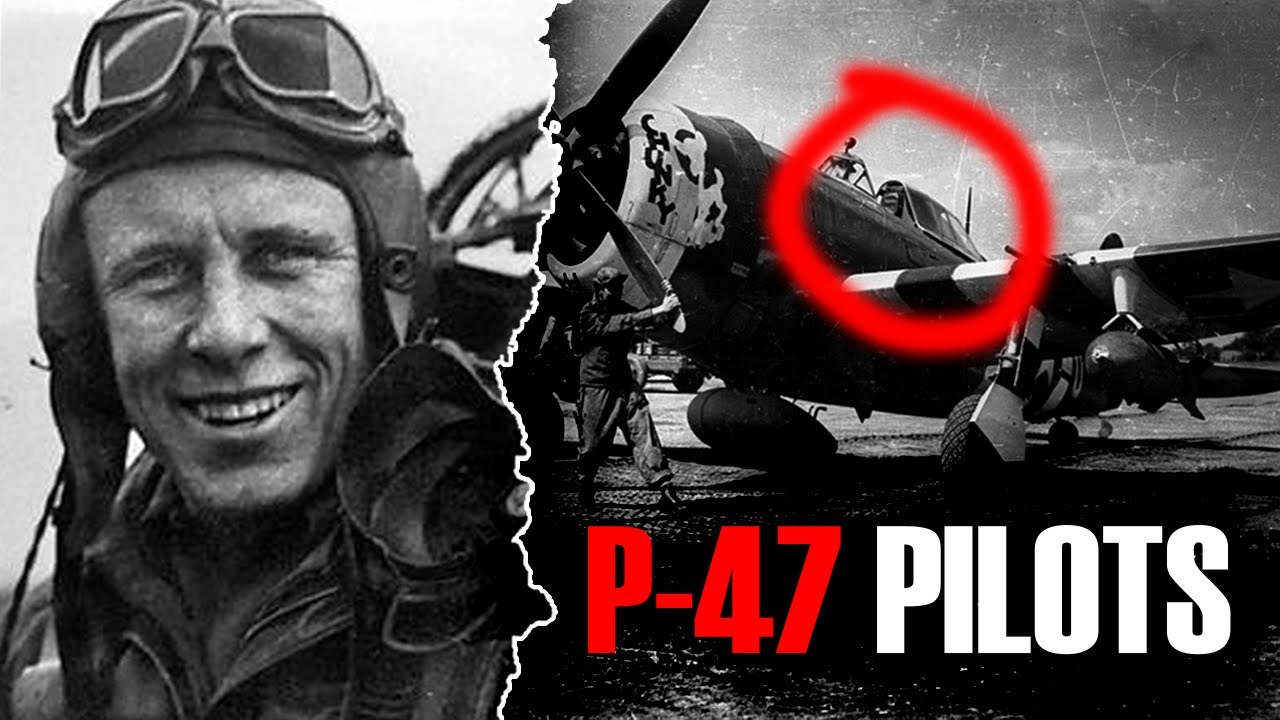
The P-47 Thunderbolt: Power, Survival, and the Dark Side of Air War
On March 19, 1945, First Lieutenant Grant G. Stout was returning from a dive-bombing mission over Germany in his P-47 Thunderbolt. Spotting a train below, he descended to strafe it one of the many dangerous low-level attacks Thunderbolt pilots carried out during the final months of World War II.
Moments later, witnesses saw his aircraft break apart in midair. Stout parachuted safely, but he was never seen again. The truth of what happened would surface only years later, leaving a haunting legacy for his family and revealing a darker side of aerial warfare.
Stout was not alone. His fate was shared by other Thunderbolt pilots whose missions brought them face to face not only with enemy fire, but with the chaos and brutality of a collapsing wartime society. To understand how this came to be, we must first look at the aircraft itself—
and the doctrine that shaped it.
Before the War: Bombers Over Fighters
In the years leading up to World War II, U.S. air power doctrine was firmly centered on long-range bombers. American military planners believed wars could be won from the air by destroying enemy factories, infrastructure, and supply lines. As a result, enormous effort went into aircraft like the B-17 Flying Fortress.
Fighters then known as pursuit planes were considered secondary. They were designed mainly as short-range interceptors to defend the American mainland against unlikely enemy air attacks. With little emphasis placed on fighter development, the United States entered the war behind Europe in this critical area.
Germany, by contrast, invested heavily in fighter aircraft. The Messerschmitt Bf 109 was already one of the most capable fighters in the world when the war began in 1939, while Britain’s Spitfire soon proved equally formidable. American squadrons were still flying P-40 Warhawks and P-39 Airacobras serviceable aircraft, but clearly outclassed.
Combat experience quickly shattered the belief that bomber formations could defend themselves with onboard machine guns alone. The U.S. Army Air Forces urgently needed a new fighter.
Building America’s Heavyweight Fighter
The challenge was taken up by engineer Alexander Kartveli. After earlier, unimpressive designs such as the P-35 and P-43, Kartveli returned to the drawing board determined to build something radically different.
Instead of designing a lightweight, nimble fighter around a small liquid-cooled engine, Kartveli flipped conventional thinking on its head. He began with the enginea massive, air-cooled 18-cylinder Pratt & Whitney R-2800 Double Wasp producing over 2,000 horsepower and built the aircraft around it.
The result was the XP-47 prototype, eventually refined into the P-47 Thunderbolt. It was the largest and heaviest single-engine fighter of World War II, weighing over seven tons when fully loaded—more than 50% heavier than a Spitfire.
This weight created serious problems. Early versions climbed poorly, and the distinctive “razorback” fuselage severely limited rearward visibility. Worse still, the first prototype crashed due to structural failure. Yet the design team persisted, solving one issue after another until the Thunderbolt emerged as a formidable aircraft.
The Supercharger That Changed Everything
One of the Thunderbolt’s most innovative features was its turbo-supercharger system. Instead of mounting the supercharger in the nose, engineers placed it deep in the fuselage. Air entered through a massive scoop beneath the nose, traveled through long ducts to the rear, and was compressed before being fed back into the engine.
Powered by exhaust gases, this system allowed the Thunderbolt to maintain high performance at altitudes above 27,000 feet where many other fighters struggled. The arrangement also had unexpected benefits: the ducting beneath the cockpit absorbed damage during crash landings, helped prevent the aircraft from flipping, and could even soak up enemy fire without immediate catastrophic failure.
Combined with self-sealing fuel tanks, armored cockpit plates, a rugged wing structure, and an air-cooled engine less vulnerable than liquid-cooled rivals, the P-47 earned a legendary reputation for survivability.
Pilots routinely returned from missions with entire sections of wing missing or engines riddled with 20mm cannon holes. Some aircraft survived damage that would have destroyed almost any other fighter.
Firepower and First Battles
The Thunderbolt carried unprecedented firepower. Eight .50-caliber Browning machine guns—four in each wing—fired nearly 100 rounds per second when unleashed together. The recoil alone could slow the aircraft by up to 30 mph.
It could also carry up to 2,500 pounds of bombs or rockets, making it the most heavily armed single-engine fighter of the war. This loadout foreshadowed the role that would ultimately define the Thunderbolt.
Its combat debut in Europe came in March 1943. Though early missions were plagued by weather and communication issues, the aircraft soon proved itself, scoring victories against formidable opponents like the Focke-Wulf Fw 190.
Initially, pilots transitioning from lighter fighters were skeptical. The P-47 was not nimble in tight turns. Instead, it relied on raw horsepower, stability, and diving speed. Once pilots adapted their tactics, the Thunderbolt became a favorite.
Fixing the Flaws
Early P-47s suffered from poor climb performance due to an inefficient propeller. German pilots exploited this weakness by climbing away from combat when engagements turned against them.
Later versions fixed the problem with a wide “paddle” propeller and added water injection—an alcohol-water mixture that temporarily boosted engine power by nearly one-third. This gave pilots a crucial edge in emergencies.
The Thunderbolt also excelled in vertical dives. It could exceed 500 mph without structural failure, something many German fighters could not safely do. When in trouble, P-47 pilots often dove straight down, escaping opponents who dared not follow.
Stories of survival became legendary. Lieutenant Robert Johnson’s Thunderbolt survived multiple cannon hits and over 100 machine-gun rounds. The stunned German ace who attacked him reportedly pulled alongside, saluted, and disengaged.
Low-Level War and Dark Endings
As the P-51 Mustang took over long-range bomber escort duties, the Thunderbolt found a new role: ground attack.
Its durability and payload capacity made it ideal for close air support. Thunderbolts devastated German trains, convoys, and armored vehicles, flying dangerously low where every anti-aircraft weapon could reach them.
While the aircraft often survived damage, pilots who bailed out behind enemy lines faced a grim fate. By 1944–45, Allied bombing and strafing had devastated German cities. Civilians, enraged by loss and hardship, increasingly took revenge on downed airmen.
Nazi propaganda labeled Allied pilots “terror fliers,” and discipline within Germany was breaking down. Some captured airmen were beaten or killed by mobs, often with authorities looking the other way.
The Fate of Grant G. Stout
After being shot down near Dortmund, Lieutenant Stout was captured by Luftwaffe personnel. Instead of being sent to a POW camp, he was marched into a village and handed over to civilians. He was beaten to death and buried in an unmarked grave. Postwar investigations led to war crimes trials, and several perpetrators were sentenced.
The Death of Major William “Shorty” Bales
On April 13, 1945, Major Bales crash-landed after his P-47 was damaged by ground fire. Earlier that same day, bombing had struck a nearby town. When Bales attempted to surrender, civilians shot him. He died the next day in a hospital at just 29 years old.
It is estimated that around 1,000 such incidents involving captured Allied airmen were recorded. While many Germans showed decency and compassion, these crimes revealed how brutal the war’s final months had become.
The Jug’s Legacy
By war’s end, more than 15,500 P-47 Thunderbolts had been built—more than any other U.S. fighter. Its pilots flew over half a million combat sorties, destroyed thousands of enemy vehicles, and shot down more than 3,700 aircraft.
The Thunderbolt helped secure Allied victory in Europe and later served in the Pacific and Korea. Though eventually replaced by jets, its philosophy lived on in the A-10 Thunderbolt II—another heavily armored, brutally effective ground-attack aircraft.
The P-47 was never the lightest or most elegant fighter. But it was powerful, resilient, and relentless—an aircraft that embodied both the technological brilliance and the moral darkness of total war.