When Supply Lines Became Front Lines
By the late 1960s, U.S. forces in Vietnam were stretched across remote bases, and everything they needed fuel, food, ammunition, spare parts had to move by road.
The problem? Those roads were perfect ambush territory.
Narrow, winding, unpaved routes cut through jungles and mountains. Names like Devil’s Hairpin and Death Valley weren’t exaggerations. Thick foliage pressed right up to the roadside. Blind curves appeared every few hundred meters.
Convoys weren’t designed for war but war found them anyway.
The Reality of Unprotected Convoys
Most supply convoys had almost no real protection:
- A few jeeps with mounted M60 machine guns
- No tanks
- No armored personnel carriers
- Drivers who weren’t trained as combat soldiers
There were no safe zones in Vietnam. No clear front lines. Just danger everywhere.
The North Vietnamese Army and the Viet Cong understood that perfectly. They waited. They watched. And when they struck, it only took minutes to destroy an entire convoy.
Eventually… something had to change.
The Ambush That Changed Everything (1967)
On September 2, 1967, a 39-vehicle convoy from the 8th Transportation Group left Pleiku, heading toward the coastal city of Qui Nhon.
The trip was supposed to be routine.
But a 5,000-gallon fuel tanker in the rear struggled to keep up, creating a 500-meter gap between the convoy’s front and rear.
Only two escort jeeps with M60s were assigned.
Then it happened.
A 57mm rocket slammed into the lead jeep.
Gunfire erupted from the treeline.
AKs. RPGs. Mines. Recoilless rifles.
29 trucks were trapped in a 700-meter kill zone.
A fuel tanker was hit and ignited. Vehicles were disabled one after another. Drivers fought back with personal rifles and whatever little firepower they had.
Reinforcements arrived 15 minutes later but the enemy was already gone.
The Aftermath
- 9 U.S. soldiers killed
- 17 wounded
- Nearly 30 vehicles destroyed or abandoned
It was clear: Convoy crews could no longer depend on anyone else.
They had to protect themselves.
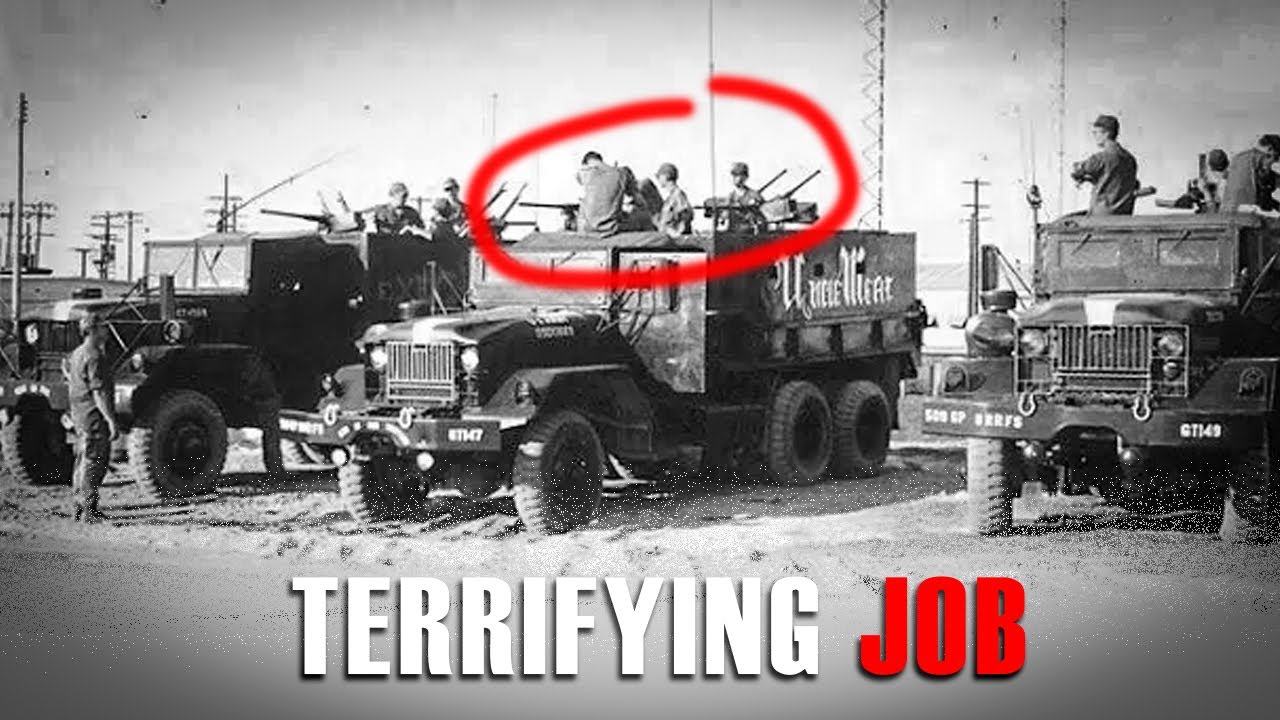
Building Armor With Scrap and Stolen Steel
The standard truck, the 2½-ton M35, had no armor.
At first, crews tried:
- Sandbags
- Sheets of plywood
It didn’t work.
Rain turned sandbags into dead weight. Axles snapped. Brakes failed. Trucks became dangerous to drive.
So they moved to steel.
Real steel.
Often “borrowed” from other units permanently.
The Birth of the “Gun Box”
Crews welded steel plates around the cargo bed:
- Four armored walls
- Sometimes double-layered steel with air gaps
- Reinforced engine bays, fuel tanks, and cab floors
The trucks became moving bunkers.
The heavier M54 5-ton trucks became preferred platforms. Even dump trucks were converted.
Then came the wildest idea:
They mounted the armored body of a damaged M113 APC onto the back of a truck.
No engine. No tracks. Just pure armor bolted into place.
It looked insane.
It worked.
Weapons That Turned Trucks Into Beast
Firepower escalated fast.
What started with a single M60 machine gun became:
- Multiple .50-caliber machine guns
- Twin and triple gun mounts
- The deadly M45 Maxon Quad Mount (four .50 cals, ~2,000 rounds per minute)
- M134 miniguns
One legendary truck “Pure Hell” used a hand-cranked minigun, like a modern Gatling gun.
No electricity.
Just muscle.
And violence.
The Men Who Manned Them
These weren’t standard soldiers.
These were drivers who became warriors.
They filled their trucks with:
- Thousands of rounds of ammunition
- Grenade launchers
- Light anti-tank weapons
- Hand grenades stacked everywhere
Many preferred older weapons they trusted:
- BARs
- Thompson submachine guns
- M1 Garands
- Even captured AK-47s
The Rise of the Gun Truck Legends
They gave their trucks names.
Not official military names personal ones.
Names that meant something.
- Untouchable
- Brutus
- The Misfits
- Eve of Destruction
- Pure Hell
These weren’t machines to them.
They were shields.
They were lifelines.
They were survival.
Built Not by Command But by Necessity
The U.S. Army didn’t design gun trucks.
The drivers did.
With scrap.
With stolen steel.
With fear.
And with the simple understanding that if they didn’t build protection…
No one would.